


The Noise Your Power Cable is Making
Cable Matters ›A power cable is the only cable in your system that is also a noise source. The Power Plus is unshielded on purpose, and this is the engineering reason why.
People mean three different things when they say a power cable is noisy. Noise getting in from outside. Noise that was already on the line before it reached your house. And noise the cable itself is sending out.
A shield handles the first one well. It barely touches the second. And for the third, which every system has including yours, it is close to the wrong tool entirely.
The noise arriving through the air
This is the one everybody pictures. Your room is full of radio-frequency energy: wifi, phone chargers, light dimmers, every digital box in the rack. That energy drifts onto any wire it can find, and a power cable is a long wire.
A shield is genuinely good at stopping it. Arriving energy meets metal before it meets your conductors, and some of it bounces off while the rest is absorbed as heat. Both of those mechanisms depend heavily on frequency, and both work best when the noise is changing fast.
One distinction matters more than any of that. Electric fields and magnetic fields are not the same problem. A conductive shield is very effective against electric fields and radio-frequency pickup. Against a magnetic field it is a different story, and a worse one.
So if your power cable runs past a dimmer circuit, shares a conduit with something switching hard, or sits in a dense rack of digital gear, the problem is real and it is in your room right now. You want a shielded cable, and we will come back to what a good one looks like.
The noise riding on the mains
The second problem is already there before your cable is involved. Every switching power supply in the building, every motor, every LED driver puts a little garbage back onto the wiring, and it arrives at your outlet traveling on the wire itself.
A shield is built to keep things out. This noise is already in. A shield can carry some common-mode and high-frequency interference, depending on how it is built and how it is connected, but it is not a filter for what rides between line and neutral and it has no mechanism to become one. Nobody should buy a cable for it.
Which kind of noise you have decides the fix. No power cable of any construction is the fix.
The noise the cable is making
The third problem is the one almost nobody counts, and it is the one your system has whether or not it has either of the others.
Run current through a wire and a magnetic field appears around it. That is not a flaw in the wire. It is just what current does. But it means your power cable is radiating a field along its entire length, and in most racks that length sits inches from every interconnect you own. The cable is not only a victim of noise. It is a source of it.

Metallurgy for shielding needs to be chosen wisely
That field is dominated by 60 Hz. At 60 Hz, an ordinary copper or aluminum cable shield gives you very little attenuation. Stopping a magnetic field at mains frequency is a different engineering problem and it wants a different material, the kind magnetism would rather travel through than around, like mu-metal. Not copper, not aluminum, and not at any thickness you would wrap around a power cable. This is ordinary electromagnetic compatibility engineering, not a cable-industry position.
What works on the third problem
There is a tool that does work on it, and it is not a material. It is the arrangement of the conductors themselves.
Anyone who listens to music already knows this trick. Play the same note through two speakers with one of them wired backwards and you get something close to silence, because the two waves are equal and opposite. Magnetic fields do the same thing.
Line and neutral carry the same current in opposite directions, so their fields are already equal and opposite. Hold the two conductors in a tightly controlled relationship down the whole length of the cable and those fields largely cancel. Nothing is absorbed, nothing is drained to ground, and nothing has to be connected for it to work. The field is not contained. It is mostly never produced.
The cancellation also improves with distance. A single wire’s field falls away slowly. A tightly held pair behaves more like a small magnetic dipole, whose field falls away far faster. So the closer and the more consistently those conductors are held together, the less is left by the time it reaches the interconnect lying beside them.
And because the cancellation comes from the opposing currents and the geometry holding them, rather than from anything absorbing a field, it holds at 60 Hz where a shield has least to offer, and keeps working on the harmonics your amplifier’s supply draws on top of it. How much you get higher up the band depends on the conductor arrangement and on how the current distributes itself.
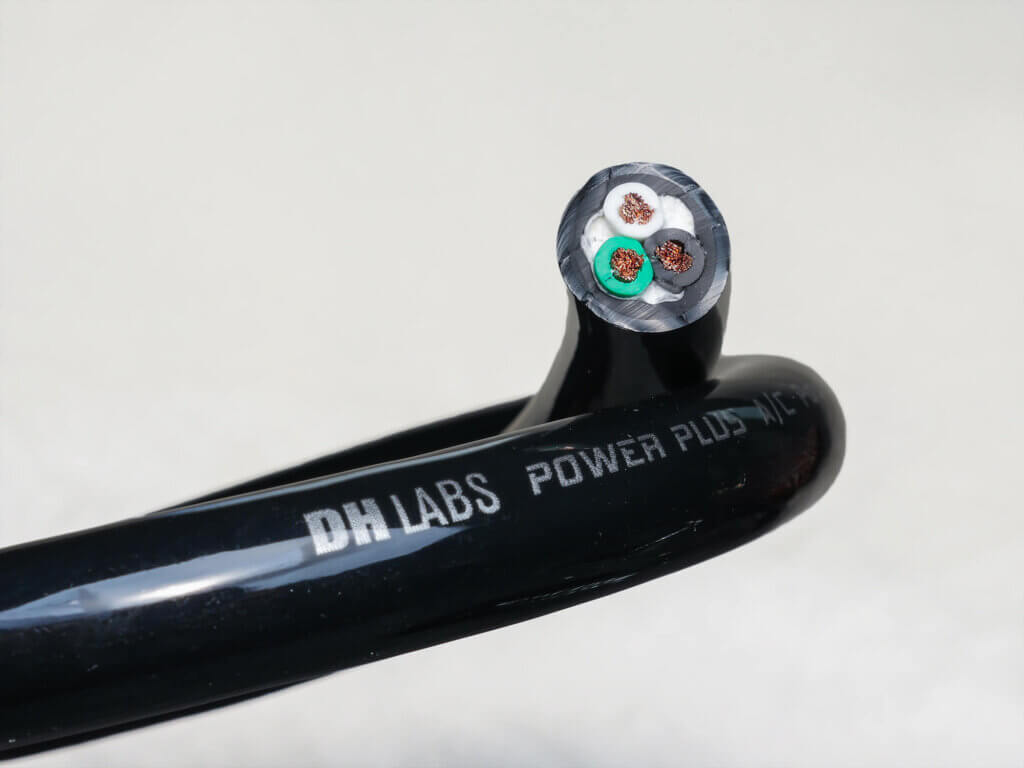
A cutaway of our Power Plus cable showing its internal geometry
That is what the Power Plus geometry does, and it is why the cable is unshielded by design rather than by omission. None of which is our discovery. Canceling a magnetic field with an equal and opposite one is settled physics, and no cable company gets to claim it. What a manufacturer can claim is how precisely it holds that geometry, over what length, and at what price.
What a shield costs when you add one
Shielding is not free. Three costs matter, and the third is where most of this category stops being honest.
It couples your conductors to ground. A shield runs the whole length of the cable, close enough to touch, and anything conductive held that close is electrically coupled to what it surrounds. That brings capacitance between conductor and shield, and a path for current into the safety ground that every chassis in your rack references. How much of it reaches your signal path depends on how your components are grounded. Where it does reach, it lands at the bottom of the dynamic range, and a raised floor takes the quietest information first.
How a shield is connected decides which interference it handles and which current paths it creates, and the right arrangement depends on the construction, the equipment at both ends, and the safety requirements that apply. That last one is not negotiable. Protective earth is a safety function, not something to rewire for a listening preference.
It spends money that could have been conductor. If the budget does not grow to cover a shield, something else shrinks, and what usually shrinks is gauge. Resistance between your wall and your amplifier becomes a voltage drop whenever current flows. More conductor lowers it. We would rather make that trade deliberately than accept it quietly.
It changes the cable’s high-frequency behavior, and this is where we stop. A shield does not restrict current delivery. That is set by conductor size and construction, insulation, connectors and rated conditions. What a shield does change is capacitance, inductance, and the way high-frequency current distributes itself. Those effects are real and they are measurable.

Shielding may not always improve sonic performance
What we cannot do is get you from there to what you hear. A change in a cable’s impedance is not the same thing as energy missing from an amplifier’s transient, which is governed by its power supply, its rectifier, its reservoir capacitors and its topology. So when you read that pulling the shield off frees up the dynamics, notice what has happened. Somebody reasoned from construction straight to a listening impression and skipped the part in between. We could write that sentence too, and it would sell this cable rather well.
All three are tradeoffs rather than problems with answers. That is the real difference between a shielded cable built properly and one that merely has a shield in it: whether the construction achieves the electrical performance it was designed for.
When a shield is the right answer, and how we build one
If you have genuine interference arriving through the air, none of the above helps you, and a shield is exactly what you need. So when we build one, this is how.
Start with what does not change. The Red Wave holds the same noise-canceling conductor geometry the Power Plus does. That arrangement is not the cheaper cable’s compensation for going without a shield. It is how we build a power cable, and it is in both of them. The Red Wave keeps it and adds to it.
What it adds is three 10 AWG conductors, 1,386 strands of silver-coated OFC, and two shields rather than one. The gauge went up rather than staying put, because a shield takes up room and we would rather add conductor than quietly subtract it. There are two layers because no single shield construction is good at everything, and layering lets each one cover what the other leaves. And a shield only earns its keep properly connected and terminated for the job it is there to do, which is where a lot of otherwise good cables quietly give the advantage back.
So the Red Wave is not the shielded alternative to an unshielded cable. It is the same answer to the problem every system has, with a second answer built on top of it for the problem some systems have.
On the cryogenic version
The Power Plus Cryo is the same design with the conductors cryogenically treated, and this is the one place in this article where we are going to be less certain than we have been everywhere else.
The proposed mechanism is worth investigating. Drawing metal into wire changes its microstructure and leaves residual stress behind, and a deep thermal cycle changes that history. What we will not tell you is that it carries through to the finished conductor’s electrical performance. Deep cooling does not relieve drawing stress the way annealing does, and a change in structure does not automatically become a change in resistance. Establishing that would take measurement we have not done.
Cryo-treatment is an upgrade option that costs what it costs, and the original Power Plus is in no way compromised without it.
So which one do you need?
You should not have to work this out from scratch.
If what you are fighting is noise already on your mains, buy neither of these yet. Work out where it is coming from. A dedicated line helps when the trouble is other loads on your own branch circuit, and does nothing about what arrives from the utility or the rest of the building. A conditioner helps when it is built for the disturbance you actually have.
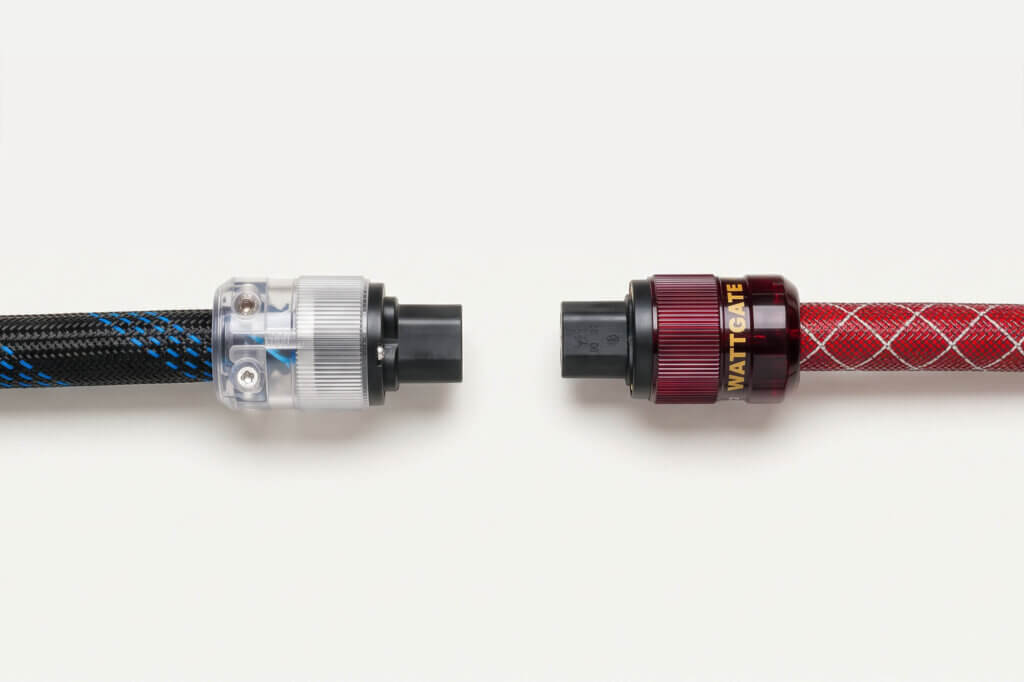
Our Power Plus and Red Wave power cables
If you have interference arriving through the air, buy the Red Wave. In our own listening it is the better cable either way, and we are not going to pretend otherwise in order to move the cheaper one. That is experience rather than a measurement, and we will call it what it is.
Otherwise, the Power Plus. What it does is deliver the part that matters most, and deliver it from three hundred dollars. There is a cable in your rack radiating a 60 Hz field at your interconnects right now, whatever is printed on its jacket. That is the problem every system has, and controlled geometry is the tool that works on it. The Power Plus is built around that one job and spends nothing on anything else.
In silver, since 1992. Alachua, Florida.