

What 8K and Atmos Ask of a Cable
Cable Matters ›An HDMI cable is asked to do more than anything else in a system, and it’s asked to do it for your picture and your sound at the same time. The Glass Master Destiny HDMI does both with light, does the rest with the best copper we know how to make, and tells you plainly which is which.
HDMI 2.1 added 8K, 120 frames per second, and full-resolution Atmos over eARC, and wire has been trying to keep up ever since.
The Glass Master Destiny HDMI exists to do one thing: get your picture and your sound out of the electrical domain entirely.
Not shielded better. Not managed more carefully. Out. Carried as light, through glass, for the full length of the run, with copper left to handle only the jobs that have to be electrical. Every choice in it went the harder way, and it’s aimed at the hardest work HDMI does.
Here’s what that takes.
What the signal is up against
HDMI 2.1 asks a cable to move up to 48 gigabits per second across four lanes that all have to arrive together, roughly two thousand times the data rate of a digital audio connection.
Worth knowing even if you never buy this cable: your sound is inside that number. HDMI doesn’t run audio on its own quiet little pair off to the side. It’s embedded in the same high-speed stream as the video, sharing the same lanes. An HDMI audio signal inherits every difficulty the video has, whether or not you’re watching anything.
Against that stream, a wire fights two enemies. Loss climbs with frequency and with distance, so the clean edges of the signal round off, and round off more the farther they travel. That’s why copper HDMI cables get thicker as they get longer, and why past a certain length they stop being passive at all. And a metal conductor interacts with electromagnetic fields. That isn’t a defect, it’s what conducting electricity means. Shielding manages the problem, and manages it well, but shielding is management. The conductor is still susceptible; it’s just being defended.
Better metal helps with the first problem. It does nothing about the second. Silver conducts better than copper, which is a large part of what we’ve been doing since 1992, and silver is still a conductor. The question was never which metal.
Now put both enemies together on a real installation. A projector hangs eight meters away across a ceiling, in a run that passes near mains wiring, a rack full of switching supplies, and whatever else lives in a modern house. That is the hardest thing anyone asks a cable to do.
The move: stop sending it as electricity
There’s one way to make a signal genuinely immune rather than merely defended, and that’s to stop sending it as electricity.
The Destiny converts the data to light at the source end, carries it optically, and converts it back at the display end. Along the path carrying your picture and your sound, no current is flowing at all. Optical loss also stays small across distance, so bandwidth and length stop trading against each other. A half-meter Destiny and an eight-meter Destiny do the same thing to the signal, which is close to nothing.
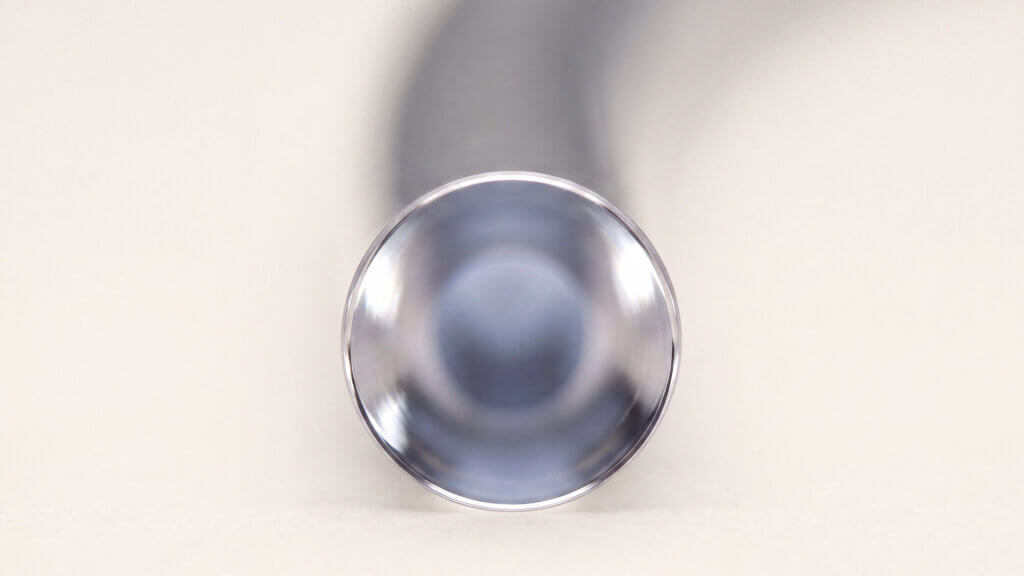
Closeup of the cutaway of one of the glass fibers in the Glass Master Destiny HDMI
Why glass, and not plastic
Most consumer optical cable uses plastic fiber: inexpensive, easy to terminate, adequate for what it’s usually asked to do. Glass costs more, is harder to work with, and accepts and carries light more precisely. The number that matters is the acceptance angle, how wide a cone of light the fiber will capture and keep.
We knew this from the Glass Master Toslink, built from 300 individual strands of real glass with connector end faces polished to an optical lens surface, because the finish on a fiber’s end decides how much light crosses the gap. We don’t know of another Toslink built that way, and the Destiny uses the same high-purity German glass.
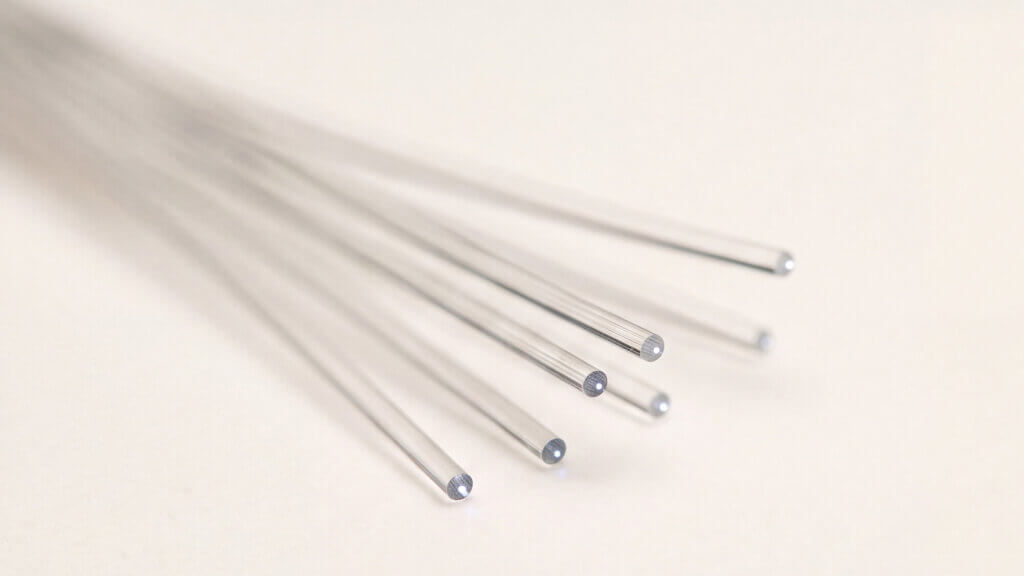
To be precise about the lineage: the Destiny doesn’t contain that 300-strand bundle, because four HDMI lanes are a different optical architecture than one audio channel. What it does share is the same quality of glass, and the same finish on the ends.
The half that’s still copper
An all-optical HDMI cable isn’t possible, and any cable claiming to be one is describing half of itself. The connector also carries a +5 volt supply, hot-plug detect, the DDC channel where two devices agree on what they can both do, and CEC control. Low-speed, partly bidirectional, none of it your picture or sound, all of it necessarily electrical. So hybrid isn’t a compromise; it’s the honest answer to what HDMI is. The question is what you do with the copper once you accept it’s there, and our position is that it should be good copper, because it runs the entire length of the cable right alongside the optics and it’s the path noise would take if it took one.
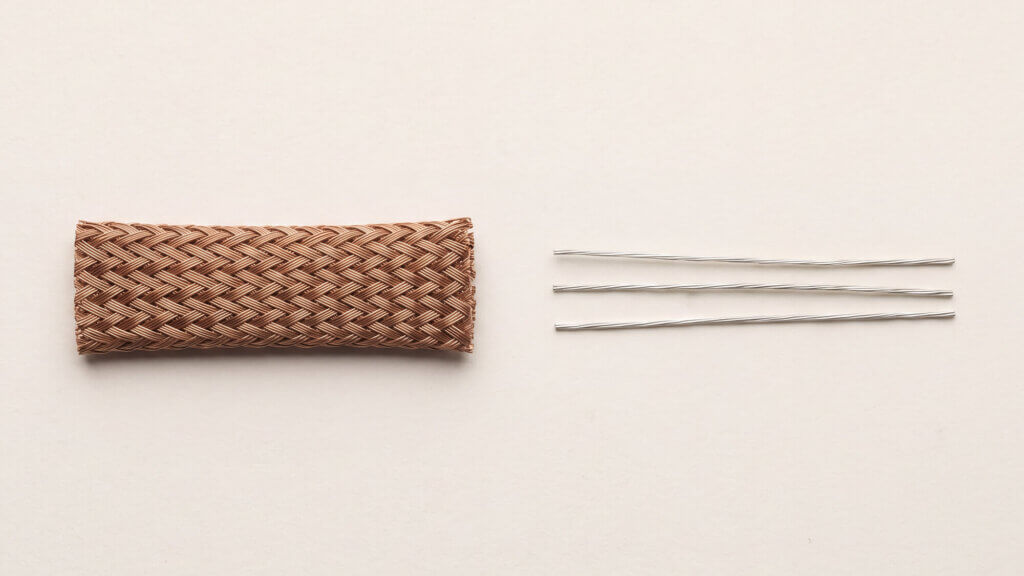
Our answer: 22 AWG silver-coated Continuous Crystal copper, the conductor family we’ve built since 1992, silver-coated because at high frequency the signal travels on the conductor’s outer surface. A braided copper shield rather than the aluminum foil or aluminum braid most of the category uses, because copper conducts better and a braid keeps working through the flexing of a real installation. Low-density PTFE dielectric instead of PVC or polyethylene, so less of the signal’s energy is stored and released by the insulation. And a 9 mm cable that stays flexible, which matters the moment you have to get it around a corner and into the back of a projector or a rack.
It’s directional, and for once that isn’t an argument
The transmitter that converts electricity to light lives in the source end. The receiver that converts it back lives in the display end. Different parts, different jobs, ends marked. Plug it in backwards and you don’t get a degraded signal, you get nothing at all, and then you turn it around and get on with your evening.
What it does for audio, and the one thing it won’t
Because the engineer in us can’t leave it out, and because these two get conflated in a way that could cost you money.
For HDMI audio the Destiny is doing exactly what it was built for: multichannel from a disc player, Atmos at full resolution, eARC back from a display, all of it embedded in the stream this cable carries as light. If sound is your only reason for buying it, you’re getting the full benefit, not a side effect of a video cable.
What it will not do is pass I2S. Some DACs and transports use the HDMI connector to carry I2S, and that’s the HDMI plug, not the HDMI protocol: raw clock and data on those pins, with none of HDMI’s signaling on top. An optical cable’s transceivers are built to encode an HDMI signal into light. Hand them something that isn’t one and they have nothing to do. So this isn’t “works with some gear.” It won’t, by design, and neither will any optical HDMI cable.
If I2S is your connection, our HDMI 2.1 is the cable we’d point you to, and we’d point you there enthusiastically. It’s built for that job, handles reference video alongside it, and starts at $170. Different cable, different problem. We’d rather tell you now than have you find out after it’s in the rack.
That’s the shape of the whole cable. Work out what genuinely has to be electrical, build that part as well as we know how, and hand the rest to the light.
The specifications, published
| Glass Master Destiny HDMI | |
| Signal path | Hybrid. Glass optical fiber carries the audio and video stream; copper carries power, control, and handshaking |
| Optical fiber | High-purity German glass, same supply as the Glass Master Toslink |
| Conductors | 22 AWG silver-coated Continuous Crystal long-grain copper |
| Shield | Three-layer, with braided copper (not aluminum foil or aluminum braid) |
| Dielectric | Low-density PTFE |
| Bandwidth | Meets and exceeds the HDMI 2.1 specification at all offered lengths |
| Video | Full HDMI 2.1 feature set, including 8K and high-frame-rate |
| Audio | Full HDMI audio, including multichannel, Atmos at full resolution, and eARC |
| Directional | Yes. Source and display ends are not interchangeable |
| Diameter | 9.0 mm |
| Lengths | 0.5 m through 8.0 m |
| I2S | Not supported. Use the DH Labs HDMI 2.1 for I2S |
| Price | From $230 (0.5 m) to $830 (8.0 m) |
In silver, since 1992. Alachua, Florida.